Pages

Showing posts with label Equalopedia. Show all posts

Sufi Teachings In Algeria: How Islam Proved Able To Solve Conflicts

Sufism, Tasawuf in Islam
In the outer region of Aljier City, the capital of Algeria, people are preparing themselves to start a new day. However, bustle that took place did not necessarily break the concentration of some people who are diligent remembrance at a mosque.

There were more than 60 people involved in that activity. Sitting cross-legged in a circle while solemnly intoned Tasbih, Takbir, Tahlil, Tahmid, and blesses the Prophet Muhammad SAW, serve Allah the Almighty God and His Messenger.

They are members of an assembly of remembrance. And just like in Indonesia, the number of assemblies of remembrance in this North African country continued to grow from time to time. One thing is important, it is worth to note, the Assembly of remembrance in the Algerian adopted most of Sufism or Tasawuf.

The development is inseparable from the role of government. They want to encourage religious activity as a priority program, especially in order to spread the Sufi teachings.

The question is, what is the urgency of the policy? As is known, this country has long conflict involving government forces with Islamic groups, and has caused huge losses of spirit and possessions.

After going through security approach; raids, detention, and even gunfire, which proved does not give good results, the Algerian government to try a new effort to stop the conflict. Encouraging the spirit of religion among the public, is now the 'guns' of the government.

Incessantly, Sufism has been echoed throughout the country. Sufism is considered as an appropriate solution to overcome the turmoil and at the same time raise awareness of the importance of peace and togetherness.

Several steps unfold immediately. Among other things, the existence of television and radio programs to disseminate Sufism. A number of influential religious figures involved to introduce and provide an understanding of these related to Sufism. These activities of course are in control of the Government.

Basically, Sufism or Tasawuf can be found in almost all Muslim-majority country in the world. Sufi followers will come first of worship to draw closer to God, whether through recitation, remembrance, and other worships. They usually choose to distance themselves from political life.

On the other hand, the Salafi teachings also shared by members of the insurgents who want to change the conditions in the country according to Islamic values. Salafi who was developed the first time in Saudi Arabia is a movement to understand the political Islamism that takes understanding of the ancestors (Salaf) of the patristic period of early Islam as a basic of understanding.

Based on that, Salafi ideology trying to revive the practice of Islam as practiced at the time of the Prophet Muhammad S.A.W. They did not want innovations that have been made and will be added in the socio-religious life of Muslims. However, in Algeria, Sufi has not practiced widely. One of the reason is because most of the mosques is more likely to follow the Salafi movement.

How many followers of the Sufism in Algeria, not known for certain. However, according to George Joffe, a researcher at the research department of the Center of International Study, University of Cambridge, currently estimated there are about one to 1.5 million followers of the Sufi of the total population of 34 million inhabitants.

Government officials believe, Sufism can create a permanent peace in Algeria. Mohamed Idir Mechnane, an official at the ministry of religious, said they worked hard to popularize the traditional teachings of Islam that emphasizes tolerance, peace, and openness.

'And Alhamdulillah (Thank God), more and more members of the public who understand and are willing to follow the Sufi teachings,' he said, quoted by Reuters news agency.

For the success of this program, the government provides a broader role in society to the followers of the Sufi. For instance, organizing events like weddings, helping orphans, teach reading and writing the Al Qur'an, as well as fund for the poor.

'For more than 14 centuries, Islam has been present in this country,' said Hadj Lakhdar Ghania, one member of the Assembly of remembrance, Tidjania Zaouia. 'We're used to living in harmony and peace.' However, he continued, when the followers of Salafi said to the Algerian to practice Islam as they practiced, then began to arise differences of opinion.

How to spread the Sufi teachings actually not a new idea. Since 2007, a study from the Rand Corporation says that Sufism proved to be very effective to promote moderate Islam. 'Traditionalist and Sufism in Islam are an integral part, given the many similarities between the two,''the study said. The Salafi followers react immediately. They can not accept some Sufi ritual practices, such as pilgrimages to the tomb of the clergy.

Instead, they assess that the Salafi doctrine is the only one should be applied. 'The Salafi is very important to counter thought and worship that deviate from Islamic values. We encourage the younger generation to follow the true teachings of Islam and not affected by the Western lifestyle,' said Sheikh Abdel Fatah, one of the prominent Salafi figures. But, why then Salafi usually associated with violent? Sheikh Abdel Fatah denies. He argues, in any countries, salafi teachings always practiced in peace.

To prove his statement, Sheikh Abdel Fatah requested that the public back to the year 2001. At that time, after 11 September 2001 incident, a number of Salafi scholars are immediately condemned the violence. Similarly, other Salafi clerics who now live in Saudi Arabia, Abdelmalek Ramdani, called on followers to avoid violence and hostility.

Other ideas put forward by Mouloudi Mohamed, a local Muslim scholar. He believes, the best effort to stop the violence is by returning to traditional practices of Islam that has taken place in a civilized country since centuries ago. 'I'm not sure we need to 'import' solutions from abroad, but it would be better if we start practicing Islam as a father and grandfather had done first,' he stated.

Source: Muslim Ways

Read more

Neil Armstrong & The Apollo 11 Moon Landing, True or Fake?

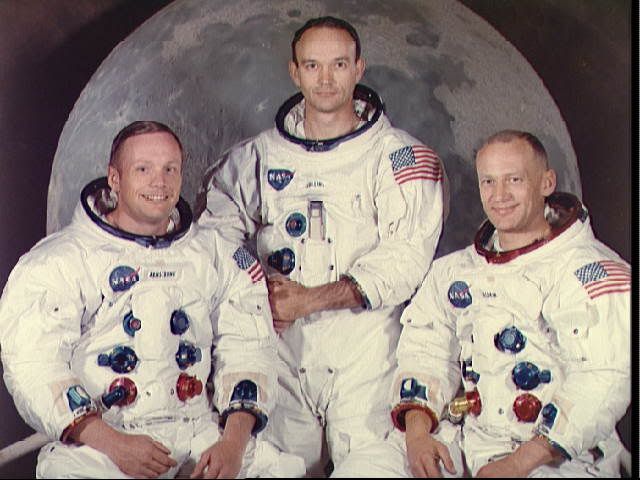
Apollo 11 Moon Landing Crew: Neil Alden Armstrong, Michael Collins, Edwin Eugene 'Buzz' Aldrin, Jr.Forty years have passed since we got shocked by the controversial news of successful Apollo 11 landing on the Moon. Is it true that astronauts Neil Armstrong was the first man on history of human kind had set foot on the Earth's satellite? Questions continue to accompany the story of the Apollo 11 mission and its landing on the surface of the Moon on 20 July 1969.

The Apollo 11 mission was the first mission conducted by U.S that to land human on the Moon surface. It was the fifth human spaceflight of Project Apollo and the third human voyage to the Moon. It was also the second all-veteran crew in manned spaceflight history.

Launched on July 16, 1969, it carried Mission Commander Neil Alden Armstrong, Command Module Pilot Michael Collins and Lunar Module Pilot Edwin Eugene 'Buzz' Aldrin, Jr. On July 20, Armstrong and Aldrin became the first humans to walk on the Moon, while Collins orbited above.

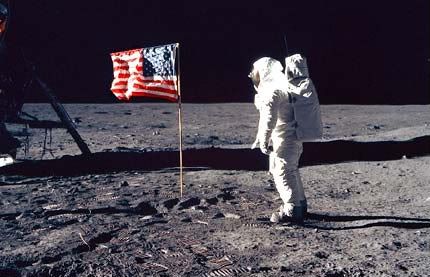
Then, astronauts Neil Armstrong and Edwin "Buzz" Aldrin walking on the surface of the Moon. Video depicts Armstrong put the U.S. flag and jump around. This action emphasizes the human success of landing on the Moon.

Several parties dispute the landing. The video clip stated as full of curiosity. Some said that the video was not made on the Moon, but in a special place in the vicinity of the State of Arizona, USA.

Astronom Phil Plait, gave an explanation on the radio program "Are We Alone", which is managed by SETI Institute, a non-profit organization in California U.S., which focus on the explanation of the existence of the other beings in the universe.

Plait said, there are some parties skeptically questioning pictures, photos, images of Armstrong and Aldrin that shows the sky without stars. "There is no atmosphere on the moon so the stars should look brighter than on earth."

The skeptical question is also about the U.S. flag in the video snippets that appear to flapped, the moon does not have air. They also propose a theory that the astronauts may have been seared by radiation when penetrate the Van Allen belt and could not have survived the trip because of exposure to radiation from the galactic ambient radiation in travel to the Moon.

Matter of fact, belief in the moon landing was already weakened in the last few years. This issue emerged again when in 2001 Fox TV broadcast a program titled "Conspiracy Theory: Did We Land on the Moon?"

The Fox TV show, said Dr. Tony Philips, on the Science@NASA site, describing how the US's NASA is not more than simply "the moronic film producer."

Neil Armstrong Apollo 11All doubt was often answered Directly by Armstrong, Apollo 11 mission commander. Armstrong who was born in Wapakoneta, Ohio, 5 August 1930, with the astronauts Buzz Aldrin admitted enjoying the surface of the Moon for 2.5 hours.

On the moon, they both drive in the U.S. flag and a banner reads "Here men from the planet Earth first set foot upon the Moon. July 1969 AD. We came in peace for all mankind."

Not only Americans are proponents of the hoax theory. A 2000 poll conducted by the Russian Public Opinion Fund found that 28 percent do not believe that American astronauts have been on the Moon and this percentage is roughly equal in all social-demographic groups.

A 2009 poll conducted by the British Engineering & Technology magazine found that 25 percent do not believe that man has walked on the Moon. For the U.S., Apollo 11 landing on the Moon is a great achievement that made the U.S. seems to excel it's main competitor, the Soviet Union, in the space program.

One of the competitors for the U.S. at this time, Russia thought, the conspiracy theory and Apollo Moon Landing hoax in 1969 is becoming increasingly popular. Russia even has created a number of sites and documentary films on television to deliver the Apollo Moon Landing hoax.

Read more

Valentina Tereshkova, The First Woman Who Visited Outer Space

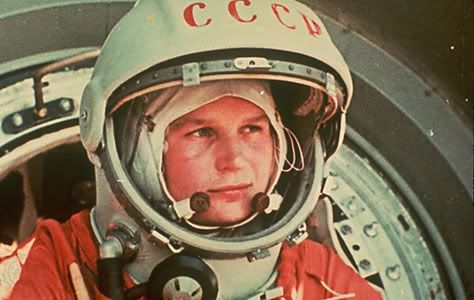
Valentina Tereshkova, Soviet Cosmonaut, The First Woman Who Visited Outer SpaceSoviet cosmonaut Valentina Tereshkova was launched into space aboard the Vostok 6 on 16 June 1963, she was becoming the first woman who visited outer space. Valentina Tereshkova spent three days aloft before returning safely to earth. The outer space flight made Tereshkova a national hero and she was awarded the high honor of the Order of Lenin.

Her flight was considered a scientific coup for the Soviet Union, which also had the first man (Yuri Gagarin) and the first dog (Laika) in space. Before her flight Tereshkova had been an avid amateur skydiver, which led to her selection for the cosmonaut corps.

Tereshkova married fellow cosmonaut Andrian Nikolayev in 1963; they had one daughter together but later separated. She was president of the Committee of Soviet Women (1968–86) and a member of the Central Committee of the Communist Party of the Soviet Union (1971).

* Name: Valentina Vladimirovna Tereshkova
* Born: 6 March 1937
* Birthplace: Maslennikovo, Russia
* Best Known As: The first woman in space

Read more

Indonesia-Malaysia Dispute Over Ambalat Block

Ambalat Block Territory Block ND 6 ND 7 Indonesia-Malaysia Dispute
Ambalat is a block located in the Celebes Sea which is currently disputable between Indonesia and Malaysia. Ambalat block is located off the coast of East Kalimantan / Borneo (one of the Indonesian province) and south-east of the Malaysian state of Sabah. Malaysia refers to part of the Ambalat block as Block ND 6 while part of the East Ambalat Block is referred to as Block ND 7. These sea blocks are rich in crude oil and natural resources.

The Indonesia-Malaysia dispute over the Ambalat Block stretch of the Celebes Sea began with the publication of a map by Malaysia Government in 1979 showing its territorial waters and continental shelf.

This map drew Malaysia's maritime boundary running in a southeast direction in the Celebes Sea from the eastmost point of the Indonesia-Malaysia land border on the eastern shore of Sebatik island, thus including the Ambalat blocks, or at least a large portion of it, within Malaysian territorial waters. Indonesia, like the other neighbouring countries of Malaysia, has protested to the map.

Indonesia on the other hand, has never officially announced the exact locations of its maritime territorial limits. Indonesia declared the islands of Sipadan and Ligitan, which both it and Malaysia once claimed and which Malaysia included as part of its territory in its 1979 map, to be its archipelagic basepoints in June 2002.

This effectively put the entire Ambalat area within its internal waters. During the International Court of Justice case over the sovereignty of Sipadan and Ligitan, Indonesia argued that the Indonesia-Malaysia maritime boundary continued as a straight line along the 4° 10' North after it left the eastern land boundary terminus on the eastern shore of Sebatik Island. This would also have put the entire Ambalat Block Indonesian territorial waters.

Source: Wikipedia

Read more

The Oldest Wine Jars From Egyptian Scorpion King's Tomb

Oldest Wine Jars From Egypt Scorpion King Tomb

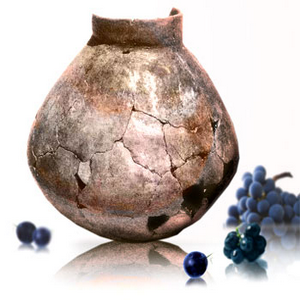
Wine may have been the beverage drunk by the people and including the King of Egypt, since thousands of years ago. At the tomb of King Scorpion I, one of the first pharaohs of Egypt, archeologists found the oldest wine jar aged 5000 years. The researchers report their findings in the journal Proceedings of the National Academy of Sciences.

However, alcoholic beverages of wine may used not just to get drunken. because, in the bottom of jar was found residue from other materials. For example, plants, herbs, resin, and other natural substances.


Ancient population of Egypt is believed to herb expert and use the herb as a treatment. Wine used to make materials are easily dissolved and separate the alkaloid substances from the plant that are useful for treatment.

"In addition to the the fact that those additive materials is tasty, they can get a lot of additional benefits to improve their health," said Professor Patrick McGovern, archeologists from the Museum of Archeology and Anthropology University of Pennsylvania, USA.

Professor McGovern has started a collaboration with researchers at the University of Pennsylvania's Abramson Cancer Center, testing compounds found in ancient fermented beverages from China, including the earliest chemically confirmed alcoholic beverage in the world, dated to 7000BC.

This oldest wine jar findings also provide new facts that this culture is developed hundreds of years earlier from the original estimates. Previous evidence shown from oldest papyrus painting aged 1850 years. Thus, the use of wine was over 1500 years older.

Read more

Introduction To Golf Games

Introduction to GolfGolf is a fun and Sporty activity. This game can play on both the individual and team. players are required to hit the ball into a hole by using some special rod called a club. Golf in the main rule is 'to play a ball with a club from the teeing ground into the hole with one or more of the brunt in accordance with the Rules'. People playing golf is usually called as golfer.

Golf came from Scotland / Netherlands and has played for approximately 500 years in Britain island. The Oldest Golf courses in the world's known is The Musselburgh Old Links Golf Course. There are some evidence shows that golf was played here in 1672, while Mary, Queen of Scotlandia has a reputation of playing there in 1567.

Read more

The Birth Of Film

Birth Of Film And Movie

The history of film spans over a hundred years, from the latter part of the 19th century to the beginning of the 21st century. Motion pictures developed gradually from a carnival novelty to one of the most important tools of communication and entertainment, and mass media in the 20th century. Motion picture films have had a substantial impact on the arts, technology, and politics.
In 1878, under the sponsorship of Leland Stanford, Eadweard Muybridge successfully photographed a horse named "Sallie Gardner" in fast motion using a series of 24 stereoscopic cameras. The first experience successfully took place on June 11 at the Palo Alto farm in California with the press present. The cameras were arranged along a track parallel to the horse's, and each of the camera shutters was controlled by a trip wire which was triggered by the horse's hooves. They were 21 inches apart to cover the 20 feet taken by the horse stride, taking pictures at one thousandth of a second. Roundhay Garden Scene 1888, the first known celluloid film recorded.

The second experimental film, Roundhay Garden Scene, filmed by Louis Le Prince on October 14, 1888 in Roundhay, Leeds, West Yorkshire, England is generally recognized as the earliest surviving motion picture.

At the Chicago 1893 World's Columbian Exposition, Muybridge gave a series of lectures on the Science of Animal Locomotion in the Zoopraxographical Hall, built specially for that purpose in the "Midway Plaisance" arm of the exposition. He used his zoopraxiscope to show his moving pictures to a paying public, making the Hall the very first commercial movie theater.

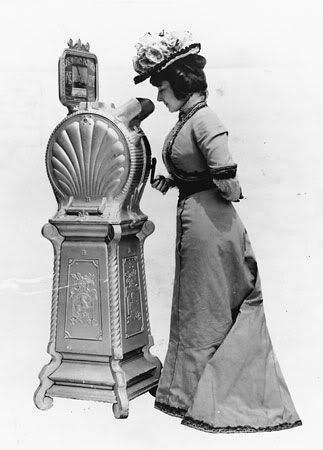
William Kennedy Laurie Dickson, chief engineer with the Edison Laboratories, is credited with the invention of a practicable form of a celluloid strip containing a sequence of images, the basis of a method of photographing and projecting moving images. Celluloid blocks were thinly sliced, then removed with heated pressure plates. After this, they were coated with a photosensitive gelatin emulsion. In 1893 at the Chicago World's Fair, Thomas Edison introduced to the public two pioneering inventions based on this innovation; the Kinetograph - the first practical moving picture camera - and the Kinetoscope. The latter was a cabinet in which a continuous loop of Dickson's celluloid film (powered by an electric motor) was back lit by an incandescent lamp and seen through a magnifying lens. The spectator viewed the image through an eye piece. Kinetoscope parlours were supplied with fifty-foot film snippets photographed by Dickson, in Edison's "Black Maria" studio (pronounced like "ma-RYE-ah"). These sequences recorded mundane events (such as Fred Ott's Sneeze, 1894) as well as entertainment acts like acrobats, music hall performers and boxing demonstrations.

Kinetoscope parlors soon spread successfully to Europe. Edison, however, never attempted to patent these instruments on the other side of the Atlantic, since they relied so greatly on previous experiments and innovations from Britain and Europe. This enabled the development of imitations, such as the camera devised by British electrician and scientific instrument maker Robert W. Paul and his partner Birt Acres.

Paul had the idea of displaying moving pictures for group audiences, rather than just to individual viewers, and invented a film projector, giving his first public showing in 1895. At about the same time, in France, Auguste and Louis Lumière invented the cinematograph, a portable, three-in-one device: camera, printer, and projector. In late 1895 in Paris, father Antoine Lumière began exhibitions of projected films before the paying public, beginning the general conversion of the medium to projection (Cook, 1990). They quickly became Europe's main producers with their actualités like Workers Leaving the Lumière Factory and comic vignettes like The Sprinkler Sprinkled (both 1895). Even Edison, initially dismissive of projection, joined the trend with the Vitascope within less than six months. The first public motion-picture film presentation in Europe, though, belongs to Max and Emil Skladanowsky of Berlin, who projected with their apparatus "Bioscop", a flickerfree duplex construction, November 1 through 31, 1895.

That same year in May, in the USA, Eugene Augustin Lauste devised his Eidoloscope for the Latham family. But the first public screening of film ever is due to Jean Aimé "Acme" Le Roy, a French photographer. On February 5, 1894, his 40th birthday, he presented his "Marvellous Cinematograph" to a group of around twenty show business men in New York City.

The movies of the time were seen mostly via temporary storefront spaces and traveling exhibitors or as acts in vaudeville programs. A film could be under a minute long and would usually present a single scene, authentic or staged, of everyday life, a public event, a sporting event or slapstick. There was little to no cinematic technique: no editing and usually no camera movement, and flat, stagey compositions. But the novelty of realistically moving photographs was enough for a motion picture industry to mushroom before the end of the century, in countries around the world.

Source: Wikipedia

Read more

History Of The Classical Guitar "From Time To Time"

History of Classical Guitar and Its Development


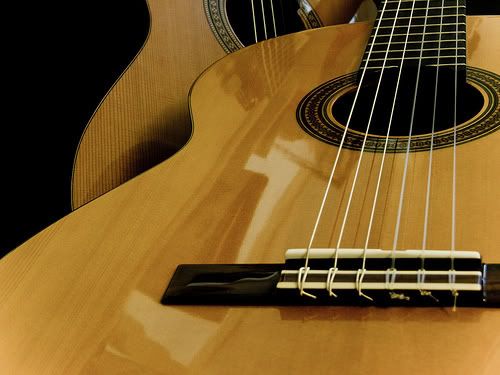
Guitar is one of musical instruments with ancient roots that is used in a wide variety of musical styles. Guitar as an instrument typically has six strings, but four strings, seven strings, eight strings, ten strings, elevenstrings, twelve strings, thirteen strings and eighteen strings guitars also exist.

Before the development of the electric guitar and the use of synthetic materials, a guitar was defined as being an instrument having "a long, fretted neck, flat wooden soundboard, ribs, and a flat back, most often with incurved sides".

Instruments similar to the guitar have been popular for at least 5,000 years. While today's classical guitar first appeared in Spain, it was itself a product of the long and complex history that saw a number of related guitar types developed and used across Europe. The roots of the guitar can be traced back thousands of years to an Indo-European origin in instruments, then known in central Asia and India.

For this reason the guitar itself is distantly related to instruments such as the tanbur and setar, and the Indian sitar. The oldest known iconographic representation of an instrument displaying all the essential features of a guitar being played is a 3,300 year old stone carving of a Hittite bard.

The modern word, guitar, was adopted into English from Spanish guitarra (German Gitarre, French Guitare), loaned from the medieval Andalusian Arabic qitara, itself derived from the Latin cithara, which in turn came from the earlier Greek word kithara, which is descended from the Old Persian word sihtar. Illustration from a Carolingian Psalter from the 9th century, showing a guitar-like plucked instrument.

The modern guitar is descended from the Roman cithara brought by the Romans to Hispania around 40 AD, and further adapted and developed with the arrival of the four-string oud, brought by the Moors after their conquest of the Iberian peninsula in the 8th century.

Elsewhere in Europe, the indigenous six-string Scandinavian lut (lute), had gained in popularity in areas of Viking incursions across the continent. Often depicted in carvings c. 800 AD, the Norse hero Gunther (also known as Gunnar), played a lute with his toes as he lay dying in a snake-pit, in the legend of Siegfried.

By 1200 AD, the four string "guitar" had evolved into two types: the guitarra morisca (Moorish guitar) which had a rounded back, wide fingerboard and several soundholes, and the guitarra latina (Latin guitar) which resembled the modern guitar with one soundhole and a narrower neck.

The Spanish vihuela or "viola da mano", a guitar-like instrument of the 15th and 16th centuries is, due to its similarities, is often considered an important influence in the development of the modern guitar. It had lute-style tuning and a guitar-like body. Its construction had as much in common with the modern guitar as with its contemporary four-course renaissance guitar.

The vihuela enjoyed only a short period of popularity; the last surviving publication of music for the instrument appeared in 1576. It is not clear whether it represented a transitional form or was simply a design that combined features of the Arabic oud and the European lute. In favor of the latter view, the reshaping of the vihuela into a guitar-like form can be seen as a strategy of differentiating the European lute visually from the Moorish oud.

Meanwhile, the five string renassance guitar and the baroque guitar enjoyed popularity, especially in Italy and France, and indeed, much of Europe from the 15th to the 18th centuries.

The Vinaccia family of luthiers is known for developing the mandolin, and may have built the oldest surviving six string guitar. Gaetano Vinaccia (1759 – after 1831) has his signature on the label of a guitar built in Naples, Italy for six strings with the date of 1779. This guitar has been examined and does not show tell-tale signs of modifications from a double-course guitar although fakes are known to exist of guitars and identifying labels from that period.

The dimensions of the modern classical guitar (also known as the Spanish guitar) were established by Antonio Torres Jurado (1817-1892), working in Seville in the 1850s. Torres and Louis Panormo of London (active 1820s-1840s) were both responsible for demonstrating the superiority of fan strutting over transverse table bracing.

Further Reading: Wikipedia

Read more

Deja Vu Phenomenon And The Mystery Of Human Perceptions

DeJa vu Phenomenon or Paramnesia means already seen

Déjà vu Phenomenon

Déjà vu is a French phrase and literally means “already seen”. Those who have experienced the feeling describe it as an overwhelming sense of familiarity with something that shouldn't be familiar at all. Term variations of deja vu, include deja vecu, meaning "already experienced", or deja senti, meaning "already felt".

This phenomenon also called paramnesia, from Greek παρα "para," "near" + μνήμη "mnēmē," "memory" or promnesia, is the experience of feeling sure that one has witnessed or experienced a new situation previously (an individual feels as though an event has already happened or has happened in the near past), although the exact circumstances of the previous encounter are uncertain.

The term was coined in 1876 by French scientists Emile Boirac in his book called "L'Avenir des Sciences Psychiques". Although he was among the first to study this bizarre phenomenon, about which we know so little and for no small reason, since it involves the complex human mind, he didn't make in depth investigations.

In Layman terms, Deja vu is, a human perception about something that was recently experienced or seen before the person involved knows he/she hasn't. A common misinterpretation of the term is related to precognitive experiences or dreams, where the person knows exactly what is going to happen and it turns out that he/she is right.
This theory was supported by many, starting from Swiss scientist Arthur Funkhouser, then by aeronautical engineer J.W. Dunne who actually conducted studies on this matter in 1939, and Nancy Sondow, who also ran a study in 1988 with almost identical results. Nevertheless, the distinction between the two is that while deja-vu's are experienced DURING an event, precognitive experiences occur BEFORE something actually happens.

The experience of déjà vu seems to be quite common among adults and children alike; in formal studies, 70% of people report having experienced it at least once. References to the experience of déjà vu are also found in literature of the past, indicating it is not a new phenomenon. It has been extremely difficult to evoke the déjà vu experience in laboratory settings, therefore making it a subject of few empirical studies. Recently, researchers have found ways to recreate this sensation using hypnosis.

Read more

Louis Braille And The History Of Braille System

Louis Braille

The Story Of Louis Braille
Louis Braille was born in a small town near Paris, Named Coupvray on 4th January, 1809. He is the 4th child from a pair of saddle horse maker that is Simon and Monique Braille. Louis grow into an intelligent children, and have a great curiousity. Because of his curiousity then at three years old an accident deprived him of his sight. At the time he was playing in his father's shop, accidentally sharp objects have been making a cuts on one of his eyes. Because of medical devices are so limited at that time, He then experienced a permanent blindness on both of his eyes.

The Beginning of the Invention
At the age of 10 years, in 1819 Louis Braille was sent to Paris Blind School named Royal Institution. He showed a remarkable development in there, in addition to the academic field, he also has a talent in playing musical instrument such as Cello, Piano and Organ.
Young Louis Braille desperately wanted to read. He realized the vast world of thought and ideas that was locked out to him because of his disability. And he was determined to find the key to this door for himself, and for all other blind persons.
Louis knew there must be a better way. There must be a way for a blind person to quickly feel the words on a page. There must be a way for a blind person to read as quickly and as easily as a sighted person. That day he set himself the goal of thinking up a system for blind people to read. He would try to think of some alphabet code to make his 'finger reading' as quick and easy as sighted reading.

He knew that he was as intelligent and creative as any other person his own age. And his musical talent showed how much he could accomplish when given a chance. One day chance walked in the door. Somebody at the school heard about an alphabet code that was being used by the French army. This code was used to deliver messages at night from officers to soldiers. The messages could not be written on paper because the soldier would have to strike a match to read it. The light from the match would give the enemy a target at which to shoot. The alphabet code was made up of small dots and dashes. These symbols were raised up off the paper so that soldiers could read them by running their fingers over them. Once the soldiers understood the code, everything worked fine.
Louis got hold of some of this code and tried it out. It was much better than reading the gigantic books with gigantic raised letters. But the army code was still slow and cumbersome. The dashes took up a lot of space on a page. Each page could only hold one or two sentences. Louis knew that he could improve this alphabet in some way.

Finally the invention is realized
On his next vacation home, he would spend all his time working on finding a way to make this improvement. When he arrived home for school vacation, he was greeted warmly by his parents. His mother and father always encouraged him on his music and other school projects. Louis sat down to think about how he could improve the system of dots and dashes. He liked the idea of the raised dots, but could do without the raised dashes. As he sat there in his father's leather shop, he picked up one of his father's blunt awls. The idea came to him in a flash. The very tool which had caused him to go blind could be used to make a raised dot alphabet that would enable him to read. The next few days he spent working on an alphabet made up entirely of six dots. The position of the different dots would represent the different letters of the alphabet. Louis used the blunt awl to punch out a sentence. He read it quickly from left to right. Everything made sense. It worked...

Louis Braille's invention continues to inspire new and innovative products that help build a world that is more inclusive for people with disabilities, such as ADA ramps, also known as "braille for the feet."

Read more

Short History of Hypnosis

Hypnosis, Hypnotism, Hypnotherapy

Hypnosys phenomenon a few years later becomes an interesting topic to be discussed. Starting from the history of the occurrence of hypnosis, how hypnosis work, and the most important is the purposes of the hypnosis method itself .
In Indonesia, some figures began to appear popularize hypnosis, like Rommy Rafael. At first he uses hypnosis methode only as an entertainment for a TV show program in one of the private television, but in the development, he also start trying to apply the science of hypnosis methods for a more fundamental needs.

The Short History Of Hypnosis

When it comes to exploring the history of hypnotism, you will find both scientific and unscientific pit stops throughout time. There is also an artistic aspect that warrants attention regarding the subject. As you study the records associated with this unique mental journey, an assortment of characters illustrate the power that hypnosis has possessed throughout the years.

To truly appreciate the longevity of hypnosis, it is vital to take a look at its use throughout ancient civilizations. While there is evidence showcasing the use of hypnosis rituals during pre-historic times, you may find one of the first intriguing visual accounts through hieroglyphics decorating the early 3000 BC tombs of ancient Egyptians. It is believed that hypnotism was utilized within various "sleep temples," which had connections to healing or religion.
Throughout ancient history, a wide range of ancient proof surrounds the fact that hypnotism was understood and practiced during numerous medicinal practices and rituals. Celtic druids to ancient Greeks to Chinese religious leaders have all shown a respect for hypnotism, as the accomplishment was also prevalent throughout Africa, Persia and South America. It is even thought that details regarding the practice of hypnosis can be found throughout the pages of the Jewish Scriptures and the Hindu Vedas.
Surrounded by spiritualism, magic and divine power, hypnotism was met with plenty of opposition for those who questioned this mysterious practice and technique. During the early years, hypnosis was a popular exercise associated with shamans, witch doctors, as well as high priests. With each passing year, there have been thousands of influences upon hypnosis, as scientific, as well as unscientific approaches contributed to the advancement of this captivating entity.

Hypnosis in the 1700s
During the 1700s, one of the most well known figures in hypnosis history is an Austrian by the name of Franz Anton Mesmer (1734-1815). Throughout the 18th century, he led the way in the usage of trace, which earned him the nickname, "Father of Hypnosis." It is also through his name that we find the term, "mesmerism."
At the urging of Mozart, Mesmer purchased a space where he could perform magical "cures" on people. While many praised his healing powers, which were often accompanied with lights and other gimmicks, there were others who dismissed his results as a figment of the imagination. One notable critic was none other than Benjamin Franklin.

Hypnosis During the 1800s
In France, one of the first scientific explorations regarding hypnosis took place with the help of Abbe Castodi de Faria. He investigated the ins and outs of the practice as it related to trances and willing participants. Faria is also credited with establishing what is known as the "fixed-gaze method," which became a rage throughout stage hypnotism shows.
Also during this time, without the effort of John Elliotson of England, the use of magnetism and hypnosis may have never found its way in easing the pain of surgery. As for the concept of autosuggestion, the thoughts and teachings of Emile Coue brought this to the public. Coue contended that all hypnosis was influenced by self-hypnotic techniques.
But during the 1800s, it was the work of Dr. James Braid that really catapulted hypnosis. Through his studies, suggestibility, as it related to trance, was thought to be an individual occurrence. Using vocal suggestion, he was able to explore the influence that hypnotists had on their subjects. Braid is also honored for discovering "waking hypnosis."

Entering the 20th Century
The history of hypnotism travels throughout a vast record in time. It was used to treat trauma victims during both World Wars. Dentists utilized its power as hypnotic-anesthesia. In 1955, the British Medical Association began to consider hypnotherapy as a legitimate medical treatment. Three years later, the American Medical Association (AMA) agreed. Following these acknowledgements throughout the medical world, a host of professional associations for hypnotists started to pop up across the globe. To date, the National Guild of Hypnotists is still the oldest and largest of its kind.
During the 20th century, many researchers, doctors and other medical figures began to take interest in learning more about hypnosis. Important strides on the subject were then made by the likes of John Kappas, Ormond McGill, Milton Erickson and Dave Elman.
To explore the history of hypnosis, one will encounter a wealth of personalities who have shaped the way people viewed and accepted the field. Well-known characters, such as Wolfgang Amadeus Mozart, Thomas Edison, Winston S. Churchill and Albert Einstein have also shown interest in hypnosis or self-hypnosis.


So how is the science of hypnosis developed, and its use in the world of health,
self-motivation, and other ... You can find in this article.

Read more

'Hologram', history and its development

Holography, Hologram, 3D Image

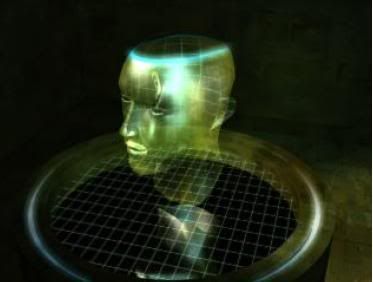
Hologram, the one of some great findings of 20th century which until this time is still experiencing the development and upgrading. Recently 360BrandVision introducing a new system that can display three-dimensional illusion holographic (3D) and can be viewed from any angle (360 degrees).
So maybe there are many of us who do not know yet about this hologram technology, how its history, how its development, and benefits of the technology generated by this one.

History of holography and the development.

In 1960, the industry was shocked with the laser technique that capable of producing three-dimensional hologram image for commercial interests. This technique is used, among others, to test the design of particular products. Visual artists are also using this technology to show their creative ideas of modern art.

Technology that become as a background of the creation to hologram is born from Hungary's physician, Dennis Gabor. He developed the theory of holography since 1947, while working in the Department of the British Thomson - Houston.
Gabor find this brilliant discovery by accident, initially Gabor theory is developing the ability to increase the electron microscope. At the time he is trying to prove his theory, he does not use the electron beam, but it uses light. With the fact of that experiment Gabor find holografi theory, the science to produce a hologram.
With the theory, Gabor successfully created the first hologram in the world. Term that Gabor use to define hologram comes from the Greek, Holo and Gramma, which means overall message.
Most of the literature said, Gabor hologram processed through the fission of a laser ray. Lajur pertama, yang disebut 'acuan', menyinari selembar lempeng peka foto atau film, sedangkan lajur kedua menyinari objek untuk diholografikan. First column, called 'reference', ray on sheet of sensitive film or an image plates , while the second row to irradiate the object to be holographised. Cahaya yang direfleksikan oleh objek ini bertubrukan diatas lempengan tadi, dan menciptakan pola gabungan yang setelah dikembangkan lagi, mampu menampilkan citra 3D. The light reflected by the object over this butt plate before, and create a pattern developed after, then its capable of displaying 3D images.
In its development, the ray which is needed to create a hologram look better, successfully found by Příbram in 1960. Pribram sangat jenius dalam meneliti konsep holografi, sehingga ia menemukan penjelasan yang telah lama dicari-cari oleh para ilmuwan otak. Příbram is examining the concept of genius in holography, so he found an explanation that has been long-sought looking by the brain scientists. Příbram revealed his thougt, that the memory is not recorded in the brain cells, but in the patterns of nerve impulse reaching the entire brain. Such as interference patterns of laser rays that penetrated the entire sheet of film containing a holographic picture. In other words, Příbram believe that the brain itself is a hologram.
In the year 1979, two Soviet scientists successfully adapted the findings of Dennis Gabor to sinehologram. Eizykman and Fihman began working together in the field of the hologram, when they become teachers at the university of Paris Cinema. With specially designed tools, they create four sinehologram measuring 35mm and 70mm. That was shown in the College of France. With funds around $58 thousands from the Fond d'intervention Culturelle, both wrestle with and then start measuring 126mm film holography. The use of this wide film is the first step to create sinehologram can be watched more than two people in the same time and from a different angle.

Read more

The Prophecies of Nostradamus vs Sabdapalon, Jayabaya and The History of Prediction

If we try find in history, occurrence of the early science prediction is difficult to ascertain. This is caused by a lack of information and ensure that valid on the early occurrence of the first science predict itself.
One important note in the history of the forecast of the world, is the presence of a Jew who lived in the year 1500. He is Michel de Nostradame, or better known as NOSTRADAMUS.

In the year 1554, NOSTRADAMUS write about the future of the world, the book that so phenomenal, and it is controversial, the Les Propheties The Prophecies. In the book, NOSTRADAMUS foresee any issues relating to the fate of the world in the future. He will predict the occurrence of French Revolution, the attack of atom bombs in Japan, the cruelty done by a leader of Germany, Adolf Hitler is named, to a suicide bomb attack on the World Trade Center towers (WTC), the United States, in 2001 ago.
Until now, the predictions he made, by the fact been correct. Although the prediction of prognosis, never spoken explicitly, but some scientist believe the forecast, that NOSTRADAMUS speech contains the truth.

In Indonesia, we know that the forecast figure of life between the years 1135 to 1157. He is Sri Mapanji Jayabaya. King of Kediri considered by some followers as a reincarnation god Vishnu, the already predict the occurrence of war will be between Indonesia and Japan. Then he also predict the appearance of a prominent leader who will take on Indonesian independence, the first President of the Republic of Indonesia, Soekarno.

Read more

The Mystery of Da Vinci's Monalisa

If we pay a visit to the city of Paris, France (a certain time we are there), do not forget to pay a visit to one of the largest museums in the world, yes ... right, True, Louvre museum.
What is the Louvre museum? not abot the Museum that we will discuss at this time, but one of the most valuable collections of the museum is. What is that?


The mystery behind the smile of Monalisa

Did you ever see the painting Monalisa? What you feel when you watch the painting? whether the painting is, in effect giving us the depth of the psychiatric condition.
Monalisa painting is the result of the work of an artist and scientist who has the intellect and extraordinary intelektualitas, Leonardo Da Vinci. This painting is one of the results of his work is most like him, but for the awards and salutes to the French King, he then gives the paintings as gifts for the King.
Modern scientists, have tried to analyze and research the depth of the painting Monalisa. They hope will be able to express emotions that are felt by girls (or widow), which became the object of this painting.
Scientists use the software a user can measure the emotional mood and feelings of a person, with the particular characteristics that are visible from the physical and visual person. One is observed as the painting of Monalisa.
This software is developed in Nicu sebe, the University of Amsterdam, the Netherlands, together with renowned scientists from the University of Illinois, the United States.
From the observation of the curvature lips, and wrinkling around the eyes, the experts concluded then estimates of the input and emotions and psychiatric conditions of figures in painting Monalisa.

The result is:
83% Happy.
9% nausea.
6% Scared .
2% angry.
However, the values obtained from the study, only results from the input line of tools and software that is capable of capturing an impression of physical and visual display only. About what is indeed perceived by leaders in the Monalisa painting, and let only the Lord, Leonardo Da Vinci, and the figures themselves that Monalisa know. We can ask yourself to that, and then later in the day.

Read more