Saudi Arabia, Indonesia pledge more protection of domestic helpers
![]() |
| Labor Minister Adel Fakieh holds talks with his Indonesian counterpart in Riyadh on Tuesday. (SPA) |
RIYADH: Saudi Arabia and Indonesia pledged at an event here on Tuesday to ensure more protection to domestic workers and have agreed to explore possibility of formulating an agreement on migrant-worker protection.
![]() |
Indonesia's Women's Affairs Minister Mrs. Linda Agum Gumelar |

Related Articles:
Gravely Ill Indonesian Worker Evacuated from Saudi Arabia Shantytown
Death of The Indonesian Worker Informed to His Family after 4 Months
Indonesian Maid Sumiati Tortured for Alleged Poor Work
Indonesia maid 'killed in Saudi Arabia'
WikiLeaks cables: Saudi princes throw parties boasting drink, drugs and sex

Govt steps up heat on Saudi Arabia over worker abuse
Indonesia’s fury over the abuse and murder of migrant workers has found no relief. A regional government has imposed a complete moratorium while the President considered reviewing the practice of sending workers to Saudi Arabia.
![]() |
Indonesian migrant worker Sumiati binti Salan Mustapa after she was brutalized by her Saudi Arabian employers. (Photo courtesy of the Saudi Gazette) |
He previously summoned the ambassador twice and sent a letter to the Kingdom’s foreign minister following the case of 23-year-old Sumiati, a West Nusa Tenggara resident who was allegedly abused by her Saudi Arabian employer.

A protest over the torture of Sumiati Binti Salan Mustapa, outside
the Saudi Arabian embassy in Jakarta. on Nov. 18. (Photo: CNN)
Long-Term Contraception Lagging as Sexually Active Singles Barred Access
![]() |
| While condoms are available and are preferred for preventing sexually transmitted diseases, many can’t access other birth control. (EPA Photo) |
Indonesia to Pay Bills for All Citizens' Births
Indonesia's Comfort Women Break the Silence
- Robbery Led to Japanese Murders: Police Jun 21, 2010
- Indonesian Killer ‘Annoyed’ Over Sacking Jun 21, 2010
- ‘Nazi Castle’ Opens New Doors on a Dark Era Apr 15, 2010
- ‘The Pacific’ Hits Indonesia’s Shores Mar 29, 2010
- Berlin’s New Gestapo Museum Chronicles Horrors Mar 5, 2010
Thirty-three provinces sign MoU on women`s empowerment
Antara News, Tuesday, June 15, 2010 03:58 WIB
Jakarta (ANTARA News) - Thirty-three provinces Monday signed a memorandum of understanding with the Ministry for Women`s Empowerment and Child Protection on harmonizing and synchronizing the central and regional governments` programs in the fields of women`s empowerment and child protection.
"This (Mou) is a kind of joint commitment we have ever made," Minister for Women`s Empowerment and Child Protection Linda Amalia Sari Gumelar said after a national coordination meeting on women`s empowerment and child protection in Bekasi east of here.
Under the MoU, both the central and provincial governments were committed to focus on achieving the goals of medium-term development plan, strategic plan and national development priority particularly in the fields of women`s empowerment and child protection.
The MoU underscored the importance of harmonizing and synchronizing the central and provincial governments` programs in the areas of women`s empowerment and child protection.
"There will be no administrative sanctions related to the commitment. But we hope the signing of MoU will lay a basis for each region to focus their attention on the programs," she said.
She expressed her belief that each province was looking forward to promoting their regions by developing programs in the fields of women`s empowerment and child protection.
"Hence, even if there will be no administrative sanctions each of the regions will implement the joint commitment well," she said.
Myth of the virginal membrane still widespread
Radio Netherlands Worldwide, 3 April 2010 - 9:00am, by Zainab Hammoud
More than half of all girls and women do not bleed when they lose their virginity. However, this loss of blood is still important in cultures where women are supposed to preserve their virginity until marriage. So women have found ways of meeting their environment's expectations.
Karima, a Dutch/Moroccan woman in her early twenties, has a secret: she had hymenoplasty, or hymen reconstruction surgery, shortly before her marriage. The hymen is the membrane which encloses the vaginal area.
"In my culture you cannot tell your parents or your family that you were not a virgin when you married. My mother would not survive it," she says. She only allows herself to be interviewed with a distorted face and voice so that she cannot be recognised.
Gynaecologist Ineke van Seumeren has doubts about the procedure. "I have always found it a problem to do something that really isn't necessary. It is not a disease." A few years ago she thought up a different solution. She wants to inform people that the correlation between an intact hymen and virginity is a myth.
Empower women against HIV from intimate partners: Minister
Dina Indrasafitri, The Jakarta Post | Wed, 03/31/2010 9:11 PM
Curbing gender disparity and increasing awareness among Indonesian women of their reproductive rights could help save them from HIV and AIDS, Women's Empowerment and Child Protection Minister Linda Amalia Sari Gumelar said Wednesday.
"We are aware that the number of women with HIV is increasing. Women in committed relationships are vulnerable to contracting HIV if their partners also have it," Linda said in Jakarta during the launching of the Report of HIV Transmission of Intimate Partner Relationships in Asia.
The report, published by UNAIDS, revealed that in 2006 there was a substantial increase in the number of women over 15 years old living with HIV in Indonesia as compared to the figure in 2002.
Indonesian women are among 50 million people in Asia at risk of being infected with HIV from long-term sexual partners.
"Currently it is necessary to increase programs targeting at strengthening women's reproductive rights and the bargaining power so that they can refuse high-risk sex," Linda said.
Irwanto, a professor from the Atmajaya University, said that it was only recently that the threat of long-term intimate relationships as possible HIV infection sources was realized.
He said a few years ago the focus had been on IDU (injection drug users). It was only recently realized that drug users were recognized to have girlfriends, wives and families, who are at high risk of contracting the disease.
Nafsiah Mboi,secretary for the National AIDS Commission, said that despite the successful campaigns on IDUs and drug use in relations the HIV, the efforts to prevent sexual transmission of HIV in the country had been much less successful.
NU Fatwa Declares Underage Girls Can Marry to Build Family Values
Jakarta Globe, Anita Rachman & Nurfika Osman, March 26, 2010
Makassar. Taking Islamic law as its guide, leading Muslim organization Nahdlatul Ulama on Friday issued a fatwa declaring underage marriage acceptable as long as the purpose of the union was to build a happy family.
Cholil Nafis, secretary of the committee for religious issues for this past week’s 32nd NU congress, said the gathering had agreed that there should be no age restrictions on marriage because sacred Islamic verses or regulations had not stipulated a minimum age.
“They can get married at any age, even girls who haven’t started menstruating,” he said. “And they can have intimate relationships and intercourse, as long as they are able.”
Cholil said Islamic law only suggested that marriages would be better after a woman had her first period.
“As long as the objectives of the marriage are positive, it is allowed,” Cholil said. “Mind you, we don’t encourage people just to get married to fulfill their desires, no,” he added.
NU was aware that some groups might disagree, he said. While NU looked at the issue from a religious point of view, others might focus on different aspects, such as human rights.
“If people disagree with our fatwa, so be it. We never force people to follow what we say.”
Cholil said an NU report mentioned underage marriages in some regions, but added that they were mostly traditional engagements between families who wanted their offspring to marry.
Under such a marriage, the minors are wed under Islamic law as if they were adults, but live separately with their families until they are judged mature enough to assume adult responsibilities.
Friday’s edict drew immediate criticism from the Indonesian Ulema Council (MUI), as well as the nation’s second-largest Islamic group, Muhammadiyah, and the National Commission on Violence Against Women (Komnas Perempuan).
“Girls need mental maturity to be responsible for their husband and children,” MUI chairman Amidhan told the Jakarta Globe. “Based on the 1974 Law on Marriage, girls can only get married after they are 16.”
Yunahar Ilyas, Muhammadiyah’s fatwa committee chairman, said NU should not issue edicts and recommendations based solely on an Islamic perspective.
“They are supposed to see this matter comprehensively. Menstruation is not a measurement of a girl’s maturity,” Yunahar said.
“She needs to be mentally and intellectually mature to be able to be a good mother and wife.”
Komnas Perempuan vice chairwoman Masruchah told the Globe that the edict violated the Law on Child Protection, which defines children as being younger than 18 years old.
Girls can begin to have their periods as early as the age of 9, but their reproductive system is still fragile and they are “not ready to be a sexually active person,” she said.
Trafficked Girl, 14, Heads Back Home

Police officers using a scarf to protect the identity of 14-year-old ‘H’ at the Child Protection Agency in Jakarta on Wednesday. The girl lived as a domestic servant in Aceh against her will for six months. (Antara Photo)
A14-year-old girl who was abducted by traffickers and taken to Aceh nearly six months ago will finally head back home to Banjarnegara in Central Java today.
The girl, identified only as “H,” was told by a recruitment agent that she would work on the staff of a cleaning service in Pekalongan, Central Java.
“Her mother was really sick and she was offered a job at Gedung Huni in Pekalongan,” said Taufik Riswan, the secretary general of the Rights of Acehnese Children Coalition. “However, after working for three days in Pekalongan, she was brought to Jakarta to see the capital.”
In Jakarta, Taufik said H was given a pill that knocked her out. When she woke up, she was on her way to the airport to be taken to Aceh.
“She was promised a job as a domestic worker in a house, and told she would be paid Rp 300,000 per month,” he said.
However, she was never paid and was forced to work from 4 a.m. to 11 p.m. each day.
“She was also beaten by the employer if she did not work well at the house,” he said, adding that the girl did not eat properly during her stay.
H told the Jakarta Globe, “I was exhausted, but I could not take any time to rest. My rest was only sleep at night.”
Though she was wearing a veil, a scar was visible on her forehead. According to Taufik, the girl’s employer gouged her with a knife.
H was rescued a month ago by Aceh Police after her employer’s neighbors reported what they had witnessed. She arrived at the office of the National Commission for Child Protection (KPAI) on Wednesday.
Three people have been named as suspects in this case. They are in the custody of Aceh Besar Police.
KPAI chairman Hadi Supeno said H’s case revealed a new pattern in human trafficking. “Aceh did not used to be a trafficking destination, but now we can see that underage children are trafficked to Aceh. It is hard for us now to map the illegal traffic as it has become more rampant. And we should take note that people who are involved in trafficking cases are those who are close with our children,” he said.
Zulaekha, from the Banjarnegara Women’s Empowerment and Child Protection Agency, told the Jakarta Globe that H’s hometown, the village of Dukuh Selimpet in Banjarnegara, was isolated and poor and known as a source of domestic workers.
She said H’s case was an indication of the existence of a trafficking network in Banjarnegara. “If we look at her case closely, many people are involved [in the trafficking network] from ojek [motorcycle taxi] drivers to employers. This is going to be our concern as working as domestic workers is a normal thing. But we may forget that the traffickers are behind this,” she said.
The International Labor Organization estimates that 100,000 Indonesian children are trafficked overseas and domestically every year, and between 40,000 and 70,000 become the victims of sexual exploitation.
Related Article:
Girl, 12, Forced to Marry 60 Year Old Man in Medan
Jakarta Globe, March 24, 2010
Child protection officials say a 12-year-old old girl in Medan, North Sumatra was forced to marry a 60-year-old man against her wishes after being beaten by her father.
Bunga (not her real name) reported her plight to the Medan office of Indonesia Child Protection Commission (KPAID) on Tuesday. Accompanied by her 28-year-old sister, Bunga said her parents forced her to marry the man in October 2009. He allegedly had been married five times already and promised to give her father a house and a motorbike in exchange for Bunga.
The older sister said Bunga was married by a cleric in front of their parents with a Rp 100 thousand ($10.94) dowry. She said Bunga refused the marriage at first but their father beat her severely with a leather belt and punched her in the head. According to the older sister, they decided to come to KPAID after a police report they filed four months ago had no effect.
The chairman of Pusaka Indonesia Foundation, of which KPAID is a member, promised to pursue the complaint.
“We will sit with the police and discuss what has been hampering them from investigating the case thoroughly. We will find solutions together; we are good friends with the police,” said Eddy Iksan.
“Our first priority is to rescue the child.” he added. “Does she still go to school? How is her mental condition? Have there been signs of trauma? We will find out whether she needs a safe house or a mentor whom she can trust. To heal her mental wounds, it is important to provide constant companion. We must not abandon the victim while we are pushing the case legally.”
He added that the organization was working to educate people that underage marriage is a form of physical, mental and sexual exploitation of children.
JG
Female drug users suffer double discrimination

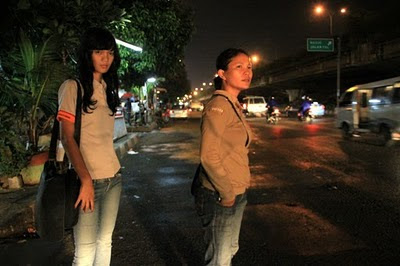
Mum and daughter: Naomi and Esta stand in the street in South Jakarta, waiting for a bus to go home in Bekasi. JP/Moch. N. Kurniawan
Naomi Esteria was 20 when she took her first hit of heroin. She is the first to admit that she spared no thought for her two-year-old daughter, Esta, or her one-year-old son, Bardonovo.
“I didn’t think about the consequences at all; I didn’t think there was any reason too,” she says. “I had no idea what heroin was or that it was addictive.”
Naomi, now 35, spent the next 12 years in the grip of an addiction that saw drug dealers share her bed more often than her two children. Even though she has been clean for two years now, she still doesn’t fully understand what motivated her behavior.
“It’s difficult to tell if you love the drugs or the person. Maybe both,” she says simply.
For the time being, Naomi’s goals are relatively simple. “I don’t know about my aspirations or hopes, but my greatest achievement is quitting drugs. It was the hardest thing I’ve ever had to do,” she says.
“It taught me that life goes on, even after addiction, and that I don’t need any idols or heroes. I am a strong woman.”
For women injecting drug users (IDUs), far more so than their male counterparts, the distinction between addiction, sex and survival are overlapping and imprecise.
“Sometimes you have to sell sex to get the drugs; sometimes you have to date the dealer,” says Sekar Wulan Sari, director of the Stigma Foundation, a community-based organization for drug users and former users. Wulan is herself a former heroin addict.
“And sometimes, as a woman, you have to stand up for your man to get the drugs.”
When asked what that means, Wulan shrugs.
“When two people love each other but there are drugs involved, often we find it is the woman who is more willing to sacrifice everything.”
While it is clear that transforming the situation for women IDUs will require thorough social, economic and legal reform, Wulan believes the priority is providing an alternative ideology to the patriarchal culture of Indonesian society.
According to UNAIDS statistics, only 10 percent of the four million recorded IDUs across East and Southeast Asia are women. Researchers, however, voice serious doubts about the accuracy of such figures. Many believe that women make up around half the IDU population in Indonesia, even though only 10 percent of the IDUs accessing hospital and clean needle services are women.
As such, much of the discussion around helping women IDUs revolves around how to reach out to an invisible population forced into hiding by severe stigma and discrimination.

Sorrow view: Former drug user Naomi Esteria Tobing and her daughter Esta Melia Suniya Anthony in a public van in Jakarta. Female IDUs are discriminated against on several fronts. JP/Moch. N. Kurniawan
“The internalization of the shame forced onto them pushes women further underground and makes them even less likely to seek assistance… In the end, women and girls suffer worse consequences compared to their male counterparts because of their substance dependence,” according to Pascal Tanguay, an information officer at the Asian Harm Reduction Network (AHRN).
Research from the AHRN, UN AIDS and the Stigma Foundation has found that women IDUs suffer more not only because of the wider social disadvantages affecting women, but also because women are still expected to fulfill “traditional” roles that cannot accommodate the reality of poverty, substance abuse and disadvantage. Patriarchal culture, which is particularly dominant in Asia, underpins an almost hysterical intolerance of women’s drug use.
“Many families are so ashamed that they would rather keep the woman IDU at home, hidden from the public, than allow her to come to the hospital,” says Ratna Mardiati, a former director of the Drug Dependence Hospital (RSKO) in East Jakarta.
The subordinate position of women in the home also hampers women’s efforts to seek medical treatment for substance abuse.
“The women [at the Drug Dependence Hospital] always have a reason for being late or for not coming at all. Firstly, they have to finish their work in the home, doing things for their children and their husband,” Ratna says.
“Or, secondly, they have no money because the man or the husband has the power and gives them their money. Even when the woman is earning money, the money will be kept by the man. Most of the relationships we see are like that.
“This means that if the husband has not given them permission to seek help, then they cannot come to hospital.”
To make matters worse, the stigma is also common among doctors, many of whom shy away from offering assistance or services to women IDUs, according Ratna.
“I don’t know if it’s that they’re not familiar with drug abuse or that they avoid providing care for these people. Maybe they judge them,” she says.
The story is much the same in the legal profession, according to Ricky Gunawan, program director at the Jakarta Community Legal Aid Institute. “Among lawyers, there is an image of drug users as a demon, as evil, so many lawyers explicitly say they don’t want to advocate for drug users,” he says.
“And I’m not just talking about commercial lawyers. Very few lawyers working for legal aid provide services for drug users.”
The discrimination and abuse faced by women IDUs is perhaps at its ugliest in the deserted back alleys of Jakarta’s slums or behind the closed blinds of a dirty police station.

“Through our work of the past one or two years, we’ve found so many cases of women IDUs who, when they were arrested or detained by police, were forced to have sexual intercourse in order to be released,” says Ricky.
Ricky and other experts believe the vast majority of women IDUs have some experience of sexual violence or abuse by police.
“When we conducted a visit to the women’s correctional facility in Tangerang, we found that all our respondents were forced to have sexual relations with police or to strip naked and stand in the street to have their bodies ‘searched’ by police.”
Police bribery, extortion and intimidation of IDUs are “standard practice”, according to lawyers and researchers. Torture of IDUs is also alarmingly commonplace, with women IDUs typically subjected to sexual torture, says Ricky.
Such was the case for Merry Christina, who in 2004 was caught injecting heroin with her boyfriend in South Jakarta. While her boyfriend was beaten and tortured in a separate room, Merry was blindfolded and gang-raped by police over five terrifying days. The pair was eventually released without charge.
Merry’s tale is not exceptional, says Ricky. He has also heard many tales of police failing to honor their side of the “deal”, even after the victim has acquiesced.
“Often the police say they’ll make the prosecution process quicker if you give them what they want…
You pay and you pay and you expect a lighter punishment, but in the end you find out it’s bulls**t. It’s all lies.”
“My goal is to increase awareness among women that they are not weak and do not need to be dominated by men,” she says.


