Indonesian Sex Slave Rescued from Shocking Abuse
Jakarta Globe, June 17, 2010
A young and badly abused Indonesian sex slave forced to have intercourse with hundreds of men over the past two months has been rescued by Malaysian authorities.
The Star online reported that the Immigration Department in Penang rescued the unidentified woman, in her 20s, from a locked room in a house in George Town on Tuesday night. She did not have any valid travel documents in her possession.
Her alleged captors, from Bangladesh, were also taken into custody.
“The Bangladeshis, who were also without any documents, were in the house then and were arrested,” the news portal quoted Immigration Department official Abdul Rahman Hassan as saying. “They have been remanded pending investigations and the woman has been sent to the Penang Hospital for a check up.”
The department reportedly received a tip-off two weeks ago that the Bangladeshis, both in their 30s, “offered” the woman to their friends for a price. She was forced to have sex with a number of men daily or else she would be beaten.
The report did not say why it took so long for Malaysian authorities to act.
The Indonesian Consulate in Penang was not available for comment.
Central Java Man Says He Sold Girl to Pay for Hair Treatments
Jakarta Globe, March 24, 2010
A man in Klaten, Central Java says he sold an underage girl as a prostitute in order to pay for his hair treatments.
Mardi, 21, was detained on Wednesday. Police said he had acted as a pimp for a 15-year-old girl named WE. The police were tipped off by local residents who grew suspicious after noticing that the girl often went to a hotel with different men.
According to police, Mardi confessed that he had sold WE to four men. Each of them paid him between Rp 70 thousand ($7.67) and Rp 100 thousand. The men were later detained and named as suspects in human trafficking.
Mardi told Metro TV he needed money to pay for his hair smoothing treatment.
“We are investigating the possibility that WE is not the only girl he sold. Our investigators from the women and children's protection unit are questioning the victim,” said Klaten Police head detective Edy Sitepu.
JG
Female drug users suffer double discrimination

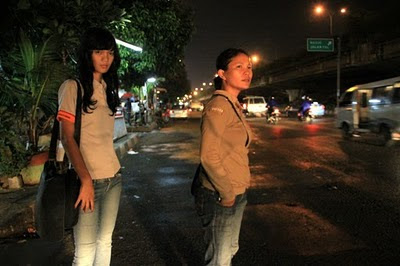
Mum and daughter: Naomi and Esta stand in the street in South Jakarta, waiting for a bus to go home in Bekasi. JP/Moch. N. Kurniawan
Naomi Esteria was 20 when she took her first hit of heroin. She is the first to admit that she spared no thought for her two-year-old daughter, Esta, or her one-year-old son, Bardonovo.
“I didn’t think about the consequences at all; I didn’t think there was any reason too,” she says. “I had no idea what heroin was or that it was addictive.”
Naomi, now 35, spent the next 12 years in the grip of an addiction that saw drug dealers share her bed more often than her two children. Even though she has been clean for two years now, she still doesn’t fully understand what motivated her behavior.
“It’s difficult to tell if you love the drugs or the person. Maybe both,” she says simply.
For the time being, Naomi’s goals are relatively simple. “I don’t know about my aspirations or hopes, but my greatest achievement is quitting drugs. It was the hardest thing I’ve ever had to do,” she says.
“It taught me that life goes on, even after addiction, and that I don’t need any idols or heroes. I am a strong woman.”
For women injecting drug users (IDUs), far more so than their male counterparts, the distinction between addiction, sex and survival are overlapping and imprecise.
“Sometimes you have to sell sex to get the drugs; sometimes you have to date the dealer,” says Sekar Wulan Sari, director of the Stigma Foundation, a community-based organization for drug users and former users. Wulan is herself a former heroin addict.
“And sometimes, as a woman, you have to stand up for your man to get the drugs.”
When asked what that means, Wulan shrugs.
“When two people love each other but there are drugs involved, often we find it is the woman who is more willing to sacrifice everything.”
While it is clear that transforming the situation for women IDUs will require thorough social, economic and legal reform, Wulan believes the priority is providing an alternative ideology to the patriarchal culture of Indonesian society.
According to UNAIDS statistics, only 10 percent of the four million recorded IDUs across East and Southeast Asia are women. Researchers, however, voice serious doubts about the accuracy of such figures. Many believe that women make up around half the IDU population in Indonesia, even though only 10 percent of the IDUs accessing hospital and clean needle services are women.
As such, much of the discussion around helping women IDUs revolves around how to reach out to an invisible population forced into hiding by severe stigma and discrimination.

Sorrow view: Former drug user Naomi Esteria Tobing and her daughter Esta Melia Suniya Anthony in a public van in Jakarta. Female IDUs are discriminated against on several fronts. JP/Moch. N. Kurniawan
“The internalization of the shame forced onto them pushes women further underground and makes them even less likely to seek assistance… In the end, women and girls suffer worse consequences compared to their male counterparts because of their substance dependence,” according to Pascal Tanguay, an information officer at the Asian Harm Reduction Network (AHRN).
Research from the AHRN, UN AIDS and the Stigma Foundation has found that women IDUs suffer more not only because of the wider social disadvantages affecting women, but also because women are still expected to fulfill “traditional” roles that cannot accommodate the reality of poverty, substance abuse and disadvantage. Patriarchal culture, which is particularly dominant in Asia, underpins an almost hysterical intolerance of women’s drug use.
“Many families are so ashamed that they would rather keep the woman IDU at home, hidden from the public, than allow her to come to the hospital,” says Ratna Mardiati, a former director of the Drug Dependence Hospital (RSKO) in East Jakarta.
The subordinate position of women in the home also hampers women’s efforts to seek medical treatment for substance abuse.
“The women [at the Drug Dependence Hospital] always have a reason for being late or for not coming at all. Firstly, they have to finish their work in the home, doing things for their children and their husband,” Ratna says.
“Or, secondly, they have no money because the man or the husband has the power and gives them their money. Even when the woman is earning money, the money will be kept by the man. Most of the relationships we see are like that.
“This means that if the husband has not given them permission to seek help, then they cannot come to hospital.”
To make matters worse, the stigma is also common among doctors, many of whom shy away from offering assistance or services to women IDUs, according Ratna.
“I don’t know if it’s that they’re not familiar with drug abuse or that they avoid providing care for these people. Maybe they judge them,” she says.
The story is much the same in the legal profession, according to Ricky Gunawan, program director at the Jakarta Community Legal Aid Institute. “Among lawyers, there is an image of drug users as a demon, as evil, so many lawyers explicitly say they don’t want to advocate for drug users,” he says.
“And I’m not just talking about commercial lawyers. Very few lawyers working for legal aid provide services for drug users.”
The discrimination and abuse faced by women IDUs is perhaps at its ugliest in the deserted back alleys of Jakarta’s slums or behind the closed blinds of a dirty police station.

“Through our work of the past one or two years, we’ve found so many cases of women IDUs who, when they were arrested or detained by police, were forced to have sexual intercourse in order to be released,” says Ricky.
Ricky and other experts believe the vast majority of women IDUs have some experience of sexual violence or abuse by police.
“When we conducted a visit to the women’s correctional facility in Tangerang, we found that all our respondents were forced to have sexual relations with police or to strip naked and stand in the street to have their bodies ‘searched’ by police.”
Police bribery, extortion and intimidation of IDUs are “standard practice”, according to lawyers and researchers. Torture of IDUs is also alarmingly commonplace, with women IDUs typically subjected to sexual torture, says Ricky.
Such was the case for Merry Christina, who in 2004 was caught injecting heroin with her boyfriend in South Jakarta. While her boyfriend was beaten and tortured in a separate room, Merry was blindfolded and gang-raped by police over five terrifying days. The pair was eventually released without charge.
Merry’s tale is not exceptional, says Ricky. He has also heard many tales of police failing to honor their side of the “deal”, even after the victim has acquiesced.
“Often the police say they’ll make the prosecution process quicker if you give them what they want…
You pay and you pay and you expect a lighter punishment, but in the end you find out it’s bulls**t. It’s all lies.”
“My goal is to increase awareness among women that they are not weak and do not need to be dominated by men,” she says.
The feminization of the HIV epidemic

JP/Moch. N. Kurniawan
The overlap between injecting drug use and sex work is a driving force in the so-called “feminization” of Asia’s HIV/AIDS epidemic.
Between 70 and 80 percent of women injecting drug users (IDUs) are involved in some kind of sex work, according to Ratna Mardiati, a former director of the Drug Dependence Hospital (RSKO) in East Jakarta with 14 years’ experience dealing with injecting drug users.
“They are not formal sex workers but they sell their bodies when they need money,” she says.
Other sources of structural inequality, such as the gender wage gap — which sees Indonesian women earning on average 75 percent of what their male counterparts earn, according to the International Labor Organization — and health insurance policies that force women to depend on their husbands for medical cover, effectively trap women in unhappy or destructive relationships.
“That is why most [women IDUs] cannot bring themselves to make a choice,” Ratna says. “They are dependent on people — on partners, firstly, and then anyone who can give them money, shelter, and whatever else they need.”
Although there is a conspicuous lack of data due to gross under-reporting, it is widely believed that sexual and other forms of abuse are common in relationships that involve drug dependence in one or both partners. In many cases, such abuse involves the male IDU selling the woman’s body for drugs or money.
Economic disadvantage combined with the social stigma also means women IDUs tend to be dependent on their partners for drugs and needles.
“It’s not good for the woman to be seen buying drugs; it’s better that she stays at home,” says Sekar Wulan Sari, director of the Stigma Foundation, a community-based organization for drug users and former users.
“The exception is when finances are stretched or supply is low. Then the responsibility shifts to the woman, probably because she can get drugs more easily by selling sex.”
However, as Asmin Fransiska — a lecturer in law and human rights at Atma Jaya University and co-founder of the Indonesian Coalition for Drug Policy Reform — points out, the problems faced by women IDUs are inseparable from the wider issue of discrimination against women. It is extremely difficult, for example, to defend the sexual rights of women IDUs in a society that in many corners still denies the existence of marital rape, she says.
“There are laws against domestic violence but… if you are the wife and you say that you are being raped by the husband, society will think: ‘What? It’s your duty to serve your body to your husband.’
You cannot just say no. It’s taboo to say no to the husband,” Asmin says.
According to researchers and health workers, this makes women IDUs exponentially more vulnerable to infection by HIV and AIDS because they are far more likely to share both drugs and injecting equipment.
“Mostly, if the woman IDU has a partner who is also a drug user, she is treated as a second class person… Even when she is the one who gets the drugs, she will give the drugs to him and he will use first. This is partly why HIV rates among women are rising – because usually, if the male IDU partner has HIV, the woman will have it too,” Asmin says.
Furthermore, given the intersection between injecting drug use, sexual violence and sex work, women IDUs are not often in a position where they can negotiate for safer sex.
Finally, compounding the economic and social factors is women’s biological susceptibility to HIV infection. According to UNAIDS, women are almost twice as likely as men to acquire HIV from an infected partner during unprotected heterosexual intercourse.
Related Article:
Indonesian Child Sex Workers Recruited on Facebook
Jakarta Globe, Amir Tejo & Dessy Sagita, February 02, 2010
Luxury goods, not the struggle for survival, lured two girls aged 15 and 16 to join a prostitution ring in Surabaya organized over the social networking site Facebook, a senior East Java Police intelligence officer said on Monday.
“Their parents were hysterical when they learned that their daughters had turned to prostitution,” Adjutant Sr. Comr. Anom Wibowo said, adding that the police were still interrogating two men from Surabaya suspected of running the ring.
Anom said the parents of the two girls were deeply distressed by the revelations and could not understand how either girl had become involved when both came from middle-class families without any financial difficulties.
Masnah Sari, chief of the Indonesian Child Protection Commission (Kpai), said luxury items were the main draw for young girls caught up in prostitution rings.
“Today, it is so easy to find a young girl selling herself to older men because she wants a Blackberry,” Masnah said, adding that underage prostitution in Indonesia was becoming harder to detect because the organizations had turned to the Internet to market their services.
“This is alarming because sex offenders can now contact the children via the Internet. They do not have to scour the red-light areas. Such crimes are occurring because parents are unable to find out what their children are getting up to on the Internet.”
Masnah has sent a letter to Communication and Information Technology Minister Tifatul Sembiring demanding that this case be monitored.
The suspects — identified as, Afif Muchilisin, 20, and Endry Margarini, also known as Vey, 20 — were arrested on Monday.
Vey had allegedly posted the girls’ pictures on his personal Facebook Web page and arranged for “hook-ups” through that account, Anom said.
Surabaya Police Chief Sr. Comr. Ike Edwin said that Vey had posted the pictures of 25 girls on Facebook.
Most of the girls, he said, were still in high school, and some were as young as 15.
Ike said that police learned of the ring following a two-week stakeout at a fast food restaurant in Surabaya, which detectives suspected was being used as a meeting point. This surveillance led to a raid on a hotel room and the arrest of two men, one of whom reportedly told police of Vey’s Facebook operation.
Related Article:
Police Identify Two Suspects in Facebook Underage Prostitution Ring

